Brinna context infrastructure
Organising the reasoning, not the files.
Brinna is context infrastructure for creative agencies. Agencies work in an industry doubling in speed and demand year on year, yet every new proposal starts from guesswork. Past projects, learnings, and hard-won client knowledge live in scattered files and in people's heads, so the same ground gets covered twice: project managers rebuild context from old briefs, and clients repeat themselves across workshops that nobody can search afterwards.
The tools that exist organise assets — a folder, a logo, a permission setting. None of them hold the thinking that produced the work: why a positioning was chosen, what research backed it, which claim came from where. Brinna holds that instead. It lives inside the tools a studio already works in and structures the reasoning behind the work, so context accumulates as an asset rather than expiring with each engagement.
This matters commercially because brand is a sensitive business asset, and rebrands fail for a consistent reason: insight never made it into the identity. Continuous context is the fix — and the same logic is why agencies increasingly embed with their clients rather than delivering a system and exiting.
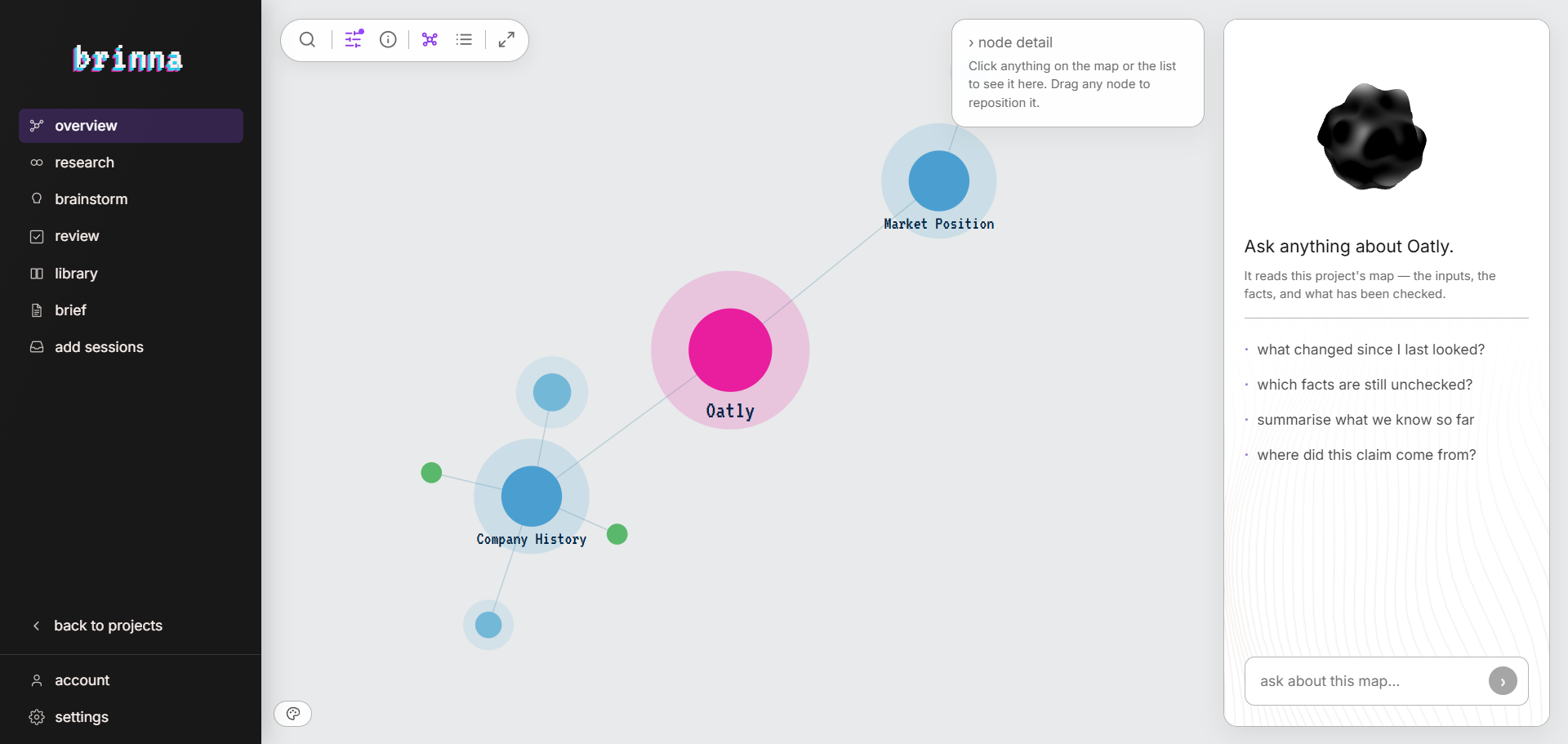
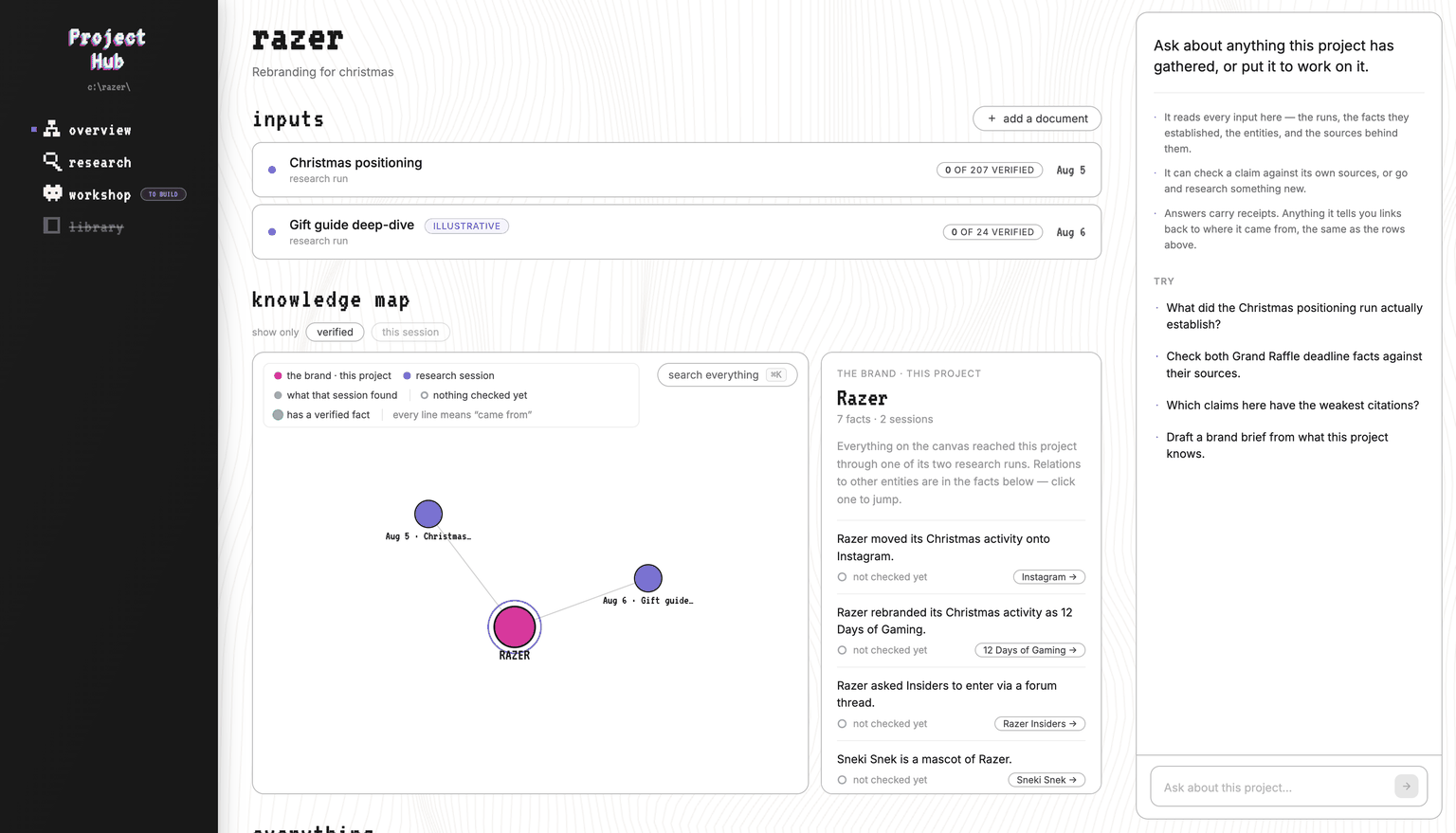
Every fact carries its source.
Research tools built on language models tend to present a confident summary and bury the question of where it came from. That is exactly the failure Brinna exists to prevent, so the interface inverts it. Capture happens first and cheaply; verification is a separate, explicit act performed per fact, on demand. Until someone checks a claim, the panel says not checked yet rather than letting it pass as settled.
Verification state therefore belongs to the visual language, not a footnote. A fact is unchecked, checked against its own sources, or checked against new research, and it looks different in each case. Every line on the knowledge map means one specific thing — came from. Designing the hub was mostly a matter of keeping that honesty legible without turning the screen into a compliance form.
Inside the studio's existing work.
Creatives will not move into another application, so Brinna does not ask them to. The capture pipeline is exposed over MCP, which means a research run starts from inside the assistant someone is already using, and what it gathers flows into the same shared graph the whole studio reads from.
Underneath is a Rust core arranged as a modular monolith behind hexagonal ports, so a new source or engine is an adapter rather than a rewrite. Postgres holds the graph, durable execution runs the research pipelines, and the customer-facing app is built in Dioxus. It runs today with early users across more than one studio.
What I work on.
- UX
- UX direction — how what gets captured and verified is shown to users, and in what order.
- UI
- Design of the customer app: project hubs, the knowledge map, entity panels, and search.
- IA
- Information architecture, worked out through interactive mockups before anything is built.
- Research
- Discovery interviews with studios, and user testing on whether people can tell a checked claim from an unchecked one.
- Decisions
- Co-signing the architecture decisions, each recorded with the conditions that would reopen it.