Tele2 Field — a Couchbase edge-resilience demo
An offline-first field-technician app, built to show jury members and executives what Couchbase Sync Gateway and Mesh can do when the network drops.
The event was a hackathon and executive workshop on edge resilience — how systems behave when the network drops, when devices are far from a data centre, or when the user happens to be inside a Faraday cage. Couchbase was the sponsor and the technology to showcase. I designed and built a demo that put their offline-first stack (Couchbase Lite, Sync Gateway, and Mesh) in front of judges and participants in a story they could understand in thirty seconds.
The story I picked: Tele2 Field, an internal mobile app for telecom field technicians. The people who actually fix the network are the people most likely to lose it — basements, tunnels, MRI wings, server rooms with thick concrete and RF shielding. Their tools have to work whether the cloud is reachable or not.
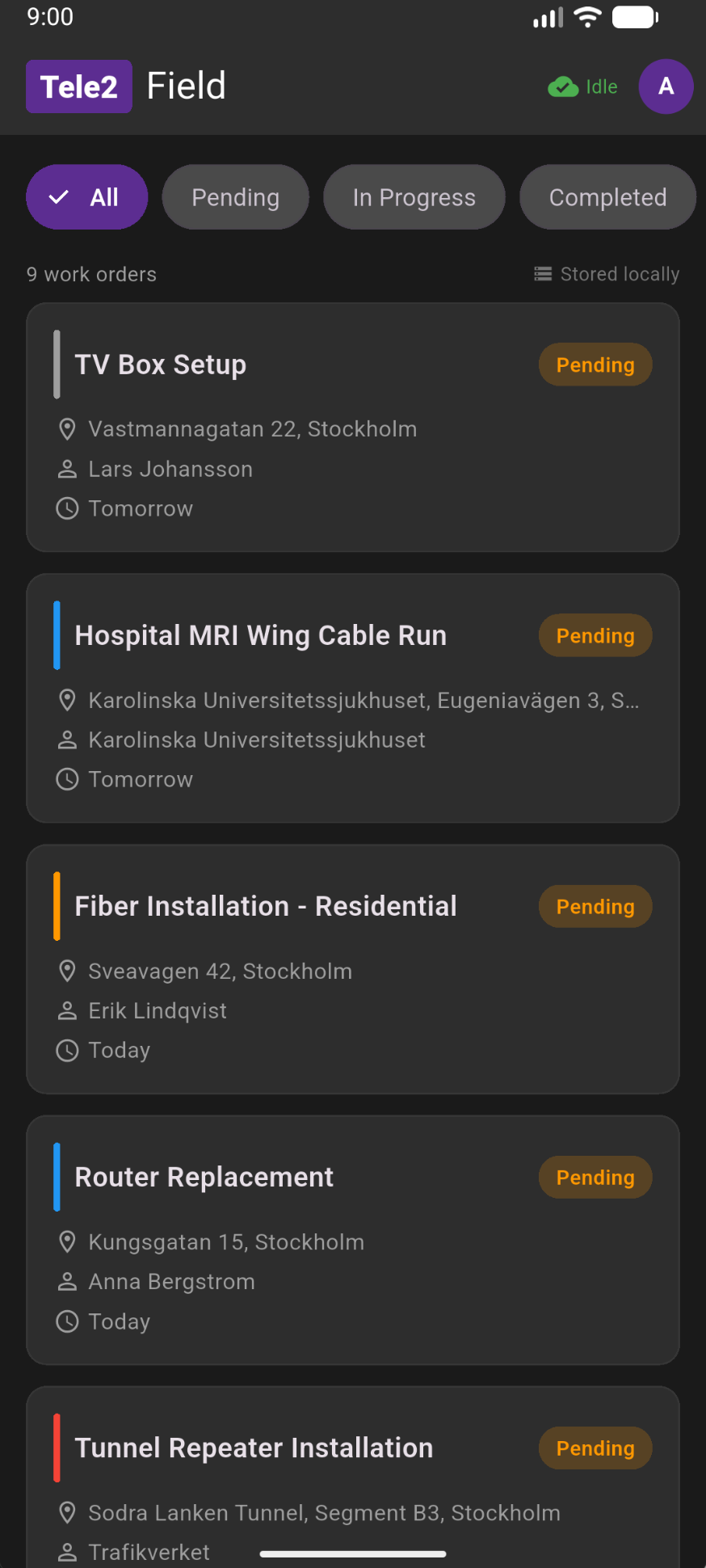
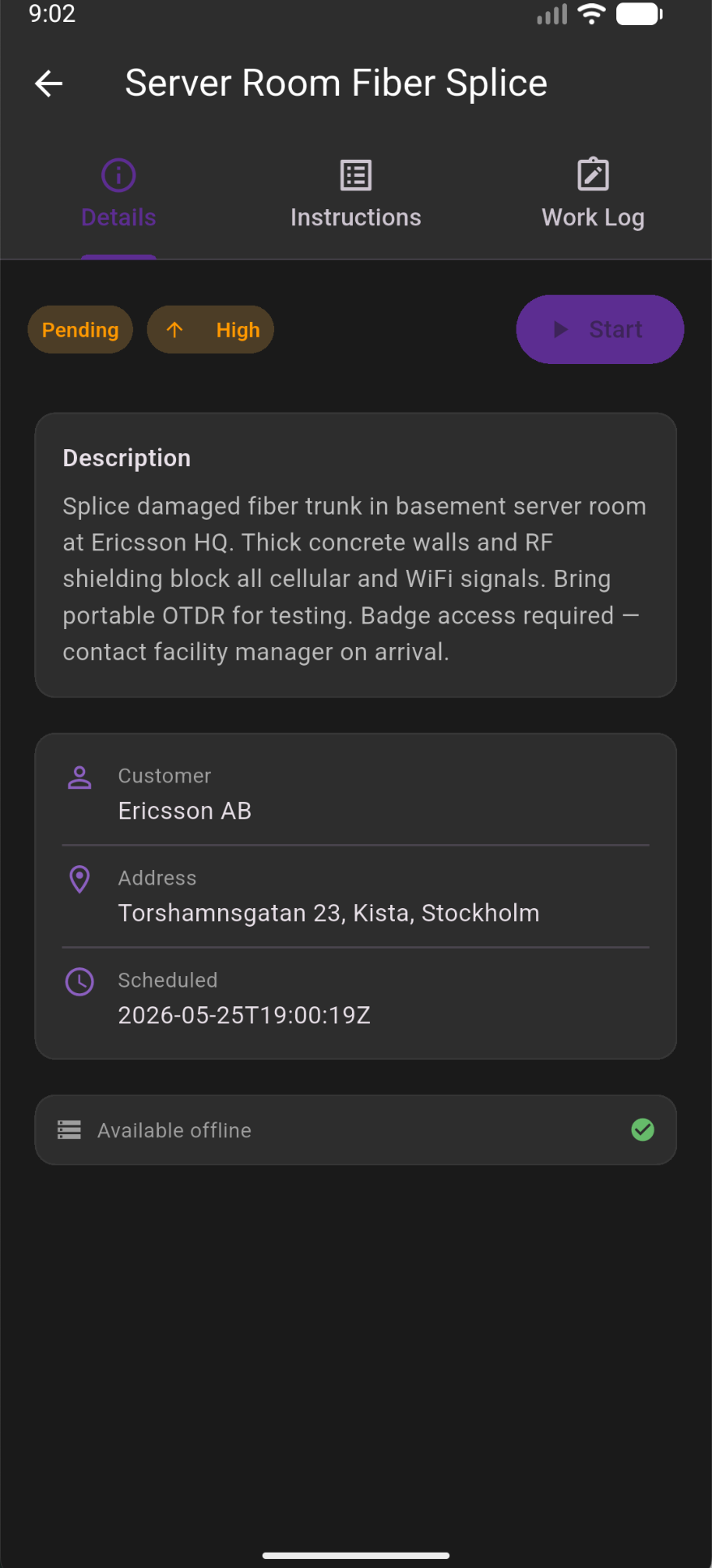
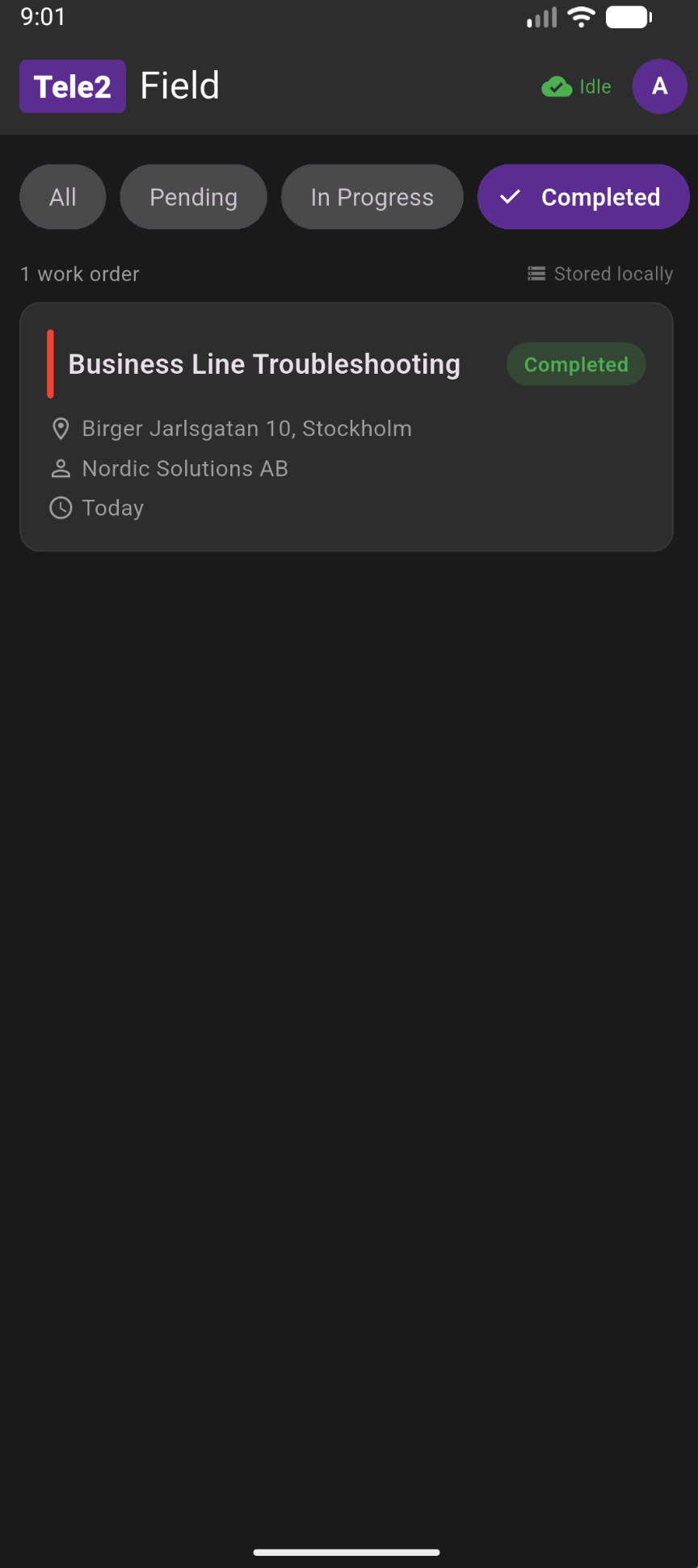
Network operators lose the network too.
A field technician's day looks like a sequence of dead zones: hospital basements blocking cellular, tunnels behind concrete, server rooms with RF-shielded racks. Cloud-first apps fall apart in those environments. The technician shows up with the wrong tool, the wrong instructions, or no idea what comes next, because the work-order manager couldn't reach the server.
The demo had to dramatise this for an executive audience. So the test case wasn't a nice clean field — it was a fiber splice in a concrete basement at Ericsson HQ.
An app that doesn't care whether the cloud is there.
The app caches every work order, every customer record, and every set of instructions locally in Couchbase Lite the moment they're assigned. A green "Idle" indicator at the top tells the technician whether the device is currently syncing or working from local storage. Either way, the data is the same.
When connectivity returns — walk back up the stairs, exit the tunnel, leave the shielded room — Couchbase Sync Gateway picks up where it left off and reconciles whatever changed on the device with the server. Couchbase Mesh lets devices on the same local network sync with each other directly when there's no path back to the cloud at all, which is how the demo handled the "everyone's in the same dead zone" scenario.
Three layers, one polytope.
The backing system was orchestrated with Polytope: a Couchbase Server cluster, a Sync Gateway in front of it, a config-manager for keyspace and seed-data wrangling, and a Flutter dev container for the app itself. Everything spun up locally for the workshop with a single command, which mattered because workshop participants were going to run their own instances on rented dev machines during the hackathon portion.
From narrative to running demo.
- 01
- Chose Tele2 Field as the narrative — a story executives could grasp in seconds and that genuinely lives or dies on offline behaviour.
- 02
- Designed the work-order list, detail, and completion flows in the Tele2 brand palette so it felt like a real internal product, not a tech demo.
- 03
- Built the Flutter app and wired it to Couchbase Lite for local persistence.
- 04
- Configured the Sync Gateway, seed data, and the Polytope orchestration so the whole stack came up reliably on demo hardware.
- 05
- Ran the live walkthrough for jury members and executive participants, intentionally dropping connectivity mid-flow to make the resilience story land.